
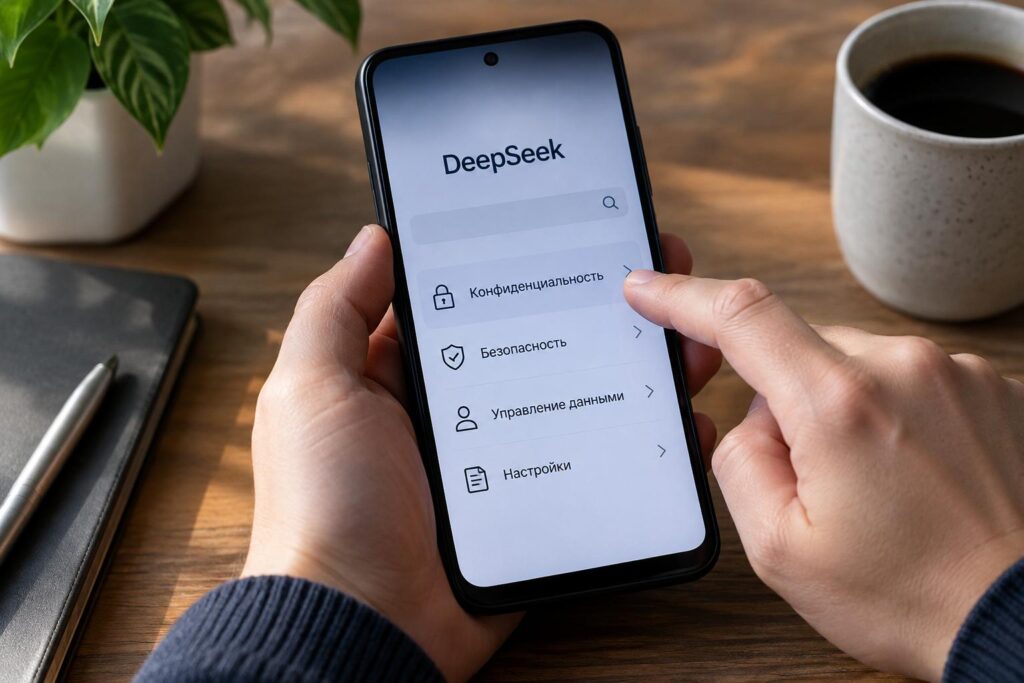
Generative AI tools have moved from curiosity to daily habit with startling speed. People now paste drafts, contracts, code, meeting notes, health questions, and half-formed business ideas into chat interfaces without much pause. That shift makes privacy less of a side issue and more of the main event, especially when the product comes from a company operating under a different legal and regulatory environment.
DeepSeek has drawn attention for its strong technical performance and fast rise in the AI market. At the same time, it has prompted a predictable but important question: what happens to the information users submit, who can access it, and how should individuals and organizations weigh the tradeoffs? To talk seriously about Безопасность и приватность в DeepSeek (конфиденциальность DeepSeek), you have to look past headlines and examine data flows, governance, infrastructure, policy language, and ordinary user behavior.
This is where many discussions go wrong. Some people assume every AI assistant is equally risky, while others wave away legitimate concerns with a casual “everyone collects data anyway.” Neither view is useful. The reality is narrower, more technical, and more practical: risk depends on what data is collected, how long it is kept, where it may be transferred, how it is secured, and whether the user understands the consequences of sharing sensitive material in the first place.
Why DeepSeek raises sharper privacy questions than a typical app
Every digital service collects something. A shopping app might store addresses and payment details, while a messaging app handles contact lists and conversation metadata. AI systems are different because users often volunteer unusually rich information in a single prompt, sometimes without realizing how revealing that prompt is.
An employee asking an AI model to “rewrite this client proposal” may be exposing names, pricing, internal strategy, and competitive positioning in one move. A developer debugging code may upload API keys, architecture details, or proprietary logic. A student might share personal records, and a patient might describe symptoms in alarming detail. The sensitivity is not theoretical; it is built into how these tools are used.
That is why the phrase “обработка данных DeepSeek” matters. The issue is not just whether DeepSeek stores data, but what categories of data it can receive, how the service may use that information, and whether users have clear controls. The more flexible the tool, the easier it becomes for sensitive data to flow into it by accident.
What privacy means in an AI context
Privacy in AI is broader than secrecy. It includes collection, storage, transfer, retention, training use, access controls, and deletion rights. A company can encrypt data in transit and still create privacy concerns if it retains user inputs for unclear periods or reserves broad rights to use content for model improvement.
There is also a practical distinction between privacy and security. Privacy concerns what data is gathered and how it is used. Security concerns how well that data is protected against unauthorized access, leaks, tampering, or theft. The two overlap, but they are not interchangeable, and confusion between them often muddies the discussion.
When evaluating AI services, I usually break the question into four plain-English tests. What goes in? Where does it go? Who can see it? How long does it stay there? If a provider cannot answer those with reasonable clarity, trust becomes a matter of guesswork.
What kinds of data AI services typically collect
Even before a user types a prompt, many platforms collect account and device information. That may include email address, phone number, IP address, browser type, device identifiers, usage logs, cookies, and app diagnostics. None of that is unusual in modern software, but it still matters because metadata can reveal patterns of behavior even when message content is protected.
Then there is the core layer: prompts, attachments, generated outputs, and interaction history. In AI systems, this layer can be far more revealing than standard app content because prompts often contain source documents, strategic questions, drafts, transcripts, or code snippets. One chat session can be a compact archive of a person’s work and thought process.
Some services also collect feedback signals. If a user rates an answer, edits a generated response, retries a prompt, or flags harmful output, those actions can become part of system improvement. This is common and often useful, but it expands the footprint of user interaction beyond the obvious message box.
Common data categories to watch
- Account information such as email, username, and billing details
- Technical data such as IP address, device type, operating system, and logs
- Prompt content, uploaded files, and generated responses
- Usage analytics, feature interactions, and feedback history
- Potential training or quality-improvement data derived from user sessions
For an ordinary consumer, that list may sound abstract. For a business, it reads like a compliance checklist. Once legal documents, customer data, or internal communications enter the system, privacy is no longer a personal preference. It becomes a governance issue.
Data processing in DeepSeek: the central question
When people discuss обработка данных DeepSeek, they are really asking how DeepSeek handles the full life cycle of submitted information. Does it log prompts? Can those prompts be reviewed internally? Are they used for training or tuning? Is retention limited? Are users given meaningful deletion options? Those are the questions that separate a cautious deployment from blind trust.
Privacy policies and terms of service deserve more attention than they usually get. They are not exciting reading, but they often reveal whether a provider reserves broad discretion over content, whether information may be transferred across borders, and whether certain data may be retained for operational or legal reasons. In AI, that fine print matters because the content itself can be so sensitive.
It is also worth noting that transparency levels vary widely across the industry. Some providers offer enterprise-grade controls, clear retention commitments, and administrative settings that limit training use. Others provide less precision, especially in consumer versions of their products. If DeepSeek is being considered for work involving confidential or regulated information, vague language should be treated as a genuine risk, not a paperwork annoyance.
Security is not the same thing as privacy, but it can save you from disaster
The phrase безопасность нейросети sounds broad, and in practice it is. For a platform like DeepSeek, security includes encryption, access controls, authentication, infrastructure hardening, monitoring, abuse prevention, and incident response. Strong privacy promises mean little if the technical defenses around the service are weak.
A secure AI platform should protect data in transit and, ideally, at rest. It should minimize internal access, log administrative actions, isolate environments, patch vulnerabilities quickly, and provide mechanisms to detect misuse. These are standard security expectations in serious software, but they become more urgent when the product is processing conversations that may contain intellectual property or personal details.
Users also play a part. A service can offer solid technical protection and still be undermined by sloppy practice on the customer side. Shared accounts, weak passwords, unreviewed browser extensions, and careless prompt habits create openings that no privacy policy can fix.
What good security controls usually include
| Control | Why it matters |
|---|---|
| Encryption in transit | Protects data while moving between user devices and servers |
| Encryption at rest | Reduces exposure if stored data is accessed improperly |
| Access controls | Limits who inside the organization can view or manage user data |
| Multi-factor authentication | Helps prevent account takeover |
| Audit logging | Creates traceability for sensitive actions and investigations |
| Retention and deletion policies | Prevents unnecessary long-term storage of sensitive content |
This is where businesses should be demanding, not polite. If an AI provider cannot clearly explain baseline safeguards, it should not receive confidential material. Performance is nice; control is better.
The legal backdrop: why jurisdiction changes the conversation
One reason DeepSeek gets unusually close scrutiny is jurisdiction. Privacy risk is not only about technology; it is also about which laws may apply to the company, its infrastructure, its employees, and any affiliated entities. A product can be elegant and still operate within a legal framework that worries foreign regulators, companies, or public agencies.
The concerns around риски китайского ИИ usually center on state access, cross-border transfers, corporate transparency, and the practical difficulty of independent oversight. Not every concern will apply equally in every case, and it is easy for public debate to become overheated. Still, the underlying issue is legitimate: when data moves into a system tied to another jurisdiction, users may lose the familiar assumptions they make about legal recourse and oversight.
This does not mean every Chinese AI system is automatically unsafe, just as it would be foolish to assume every American or European platform is safe by default. It means risk assessment must include governance, law, and political context along with pure technical analysis. That broader lens is often missing from casual app reviews but impossible to ignore in procurement decisions.
Cross-border data transfers and why they matter
Cross-border data transfer sounds like a phrase built for compliance teams, yet it affects ordinary users more than they might think. If your prompt, attachment, or account information is processed in another country, it may be subject to different surveillance regimes, disclosure obligations, data localization rules, or legal remedies. Those differences can shape what happens long after you hit send.
For multinational businesses, this becomes even more complicated. A company may be subject to sector-specific rules, contractual obligations with clients, or internal data-classification policies that restrict where certain information can be processed. In that setting, using a consumer AI tool without a formal review is less a shortcut than a gamble.
I have seen teams become excited about a new AI assistant and start testing it with real internal documents within hours. The mood is usually productive and a little chaotic. Then someone from legal or security asks a simple question: where is this data going? The room gets quiet fast.
The hidden privacy risk: people overshare with chatbots
The biggest privacy problem in generative AI is often not a breach or a malicious actor. It is a user who treats the model like a private notebook, a therapist, a coding partner, and a file repository all at once. People disclose more to chat interfaces than they would ever put into a support ticket or social post.
That instinct is understandable. The interface feels conversational, responsive, and strangely nonjudgmental. But natural language design creates a false sense of intimacy. A chatbot may sound like a confidant while functioning as a software service governed by retention rules, moderation systems, analytics tooling, and internal review processes.
With DeepSeek, as with any AI assistant, the safest assumption is plain: anything you submit should be treated as potentially reviewable, retainable, and too valuable to expose unless you have checked the rules. That sounds strict, but it is much easier to prevent oversharing than to claw back data once it is uploaded.
Data users should avoid entering into public or consumer AI tools
- Passwords, API keys, private cryptographic material, or access tokens
- Customer lists, unreleased financials, internal strategy documents, or M&A material
- Protected health information or sensitive personal records
- Attorney-client communications or legal work product
- Source code containing secrets, proprietary algorithms, or production credentials
That list is not paranoia. It is basic hygiene. Most serious incidents begin with ordinary convenience, not cinematic sabotage.
How model training complicates privacy
One of the hardest issues in AI privacy is whether user content may be used to train, fine-tune, or otherwise improve the system. Many users hear “training” and imagine a giant vacuum sucking their words into the model forever. The actual process can vary, but the concern is still valid because reuse of user data changes the stakes dramatically.
If prompts are used for training or quality improvement, users may worry about unintended memorization, exposure through future outputs, or loss of control over proprietary content. Researchers have shown that language models can sometimes reproduce training data fragments under certain conditions, especially when data is sensitive, rare, or repeated. The likelihood of any specific leak may be low, but the potential harm can be high.
That is why opt-out controls, enterprise carve-outs, and clear data-use commitments matter so much. A provider that separates consumer experimentation from enterprise confidentiality is easier to evaluate than one that wraps every use case into the same broad policy language. Without that separation, privacy becomes a matter of faith.
Business use brings higher stakes and fewer excuses
For individual users, AI privacy is often about personal caution. For companies, it is about duty. A firm that mishandles client information through an AI tool may face contractual liability, regulatory trouble, reputational damage, and internal fallout that lasts much longer than any productivity gain the tool provided.
DeepSeek may be attractive for research, drafting, coding support, or multilingual tasks, but business adoption should never begin with enthusiastic employees and end there. It needs review by security, legal, procurement, and, in regulated sectors, compliance. This is not bureaucracy for its own sake. It is the minimum needed to understand whether the tool fits the organization’s risk appetite.
In practice, the right question is not “Is DeepSeek safe?” That is too blunt to be useful. The better question is “Is DeepSeek appropriate for this category of data, this workflow, this team, and this regulatory environment?” Sometimes the answer will be yes with restrictions. Sometimes it will be no, and that is a healthy outcome.
A simple internal review framework
- Classify what data employees want to submit
- Review provider terms, privacy policy, and security documentation
- Check data residency, transfer rules, and retention commitments
- Determine whether user content is used for training or service improvement
- Set technical controls, approved use cases, and staff guidance
- Monitor usage and revise policy as the provider changes features or terms
That kind of review is not glamorous. It also prevents expensive mistakes. Most mature AI governance programs are built from exactly this sort of disciplined routine.
Account security and the often-ignored basics
Grand debates about geopolitical risk can distract from simple failures close to home. If a DeepSeek account is protected by a reused password or shared among several employees, the problem is no longer abstract. It is immediate, local, and entirely preventable.
Good account hygiene still matters. Use a unique password, enable multi-factor authentication if available, restrict access to those who actually need it, and remove stale accounts promptly. If the service offers admin tools or audit visibility, organizations should use them rather than treating the platform like a toy.
There is also the ecosystem risk. Browser extensions, mobile keyboards, clipboard managers, and third-party integrations can all expand the exposure around an AI session. People tend to focus on the model provider and forget the software sitting between their prompt and the screen.
What transparency should look like from an AI provider
Trustworthy AI vendors do not just say “we care about privacy.” They explain what data they collect, why they collect it, whether it is used for training, where it is processed, how long it is retained, what security controls exist, and what choices users have. The details do not need marketing gloss. They need clarity.
For DeepSeek, the quality of transparency is a major part of the assessment. If documentation is sparse, shifting, or broad enough to cover almost any future use, organizations should read that as a signal. Not necessarily a sign of wrongdoing, but a sign that caution is warranted.
Independent audits, security certifications, detailed enterprise agreements, and timely disclosure of policy changes all help. None of them guarantees perfect behavior. Together, though, they make it easier for customers to evaluate the service with something sturdier than hope.
How consumers can use DeepSeek more safely
Not everyone needs an enterprise review board to ask a chatbot for writing help or technical explanations. Individual users can reduce risk dramatically with a few practical habits. The key is to treat the tool as useful, not intimate.
Do not enter anything you would regret seeing copied into an email thread at work. Strip names, account numbers, and identifying details from prompts. Rewrite examples using placeholders. If you need help with a document, summarize the issue instead of pasting the full file.
It also helps to separate experimentation from identity. Use an email dedicated to app signups when appropriate, review privacy settings, and periodically delete old chats if the service allows it. Those steps are modest, but modest habits are what keep ordinary curiosity from turning into unnecessary exposure.
Practical user checklist
- Do not paste confidential documents into the chat
- Remove names, IDs, and sensitive details before submitting prompts
- Use unique credentials and enable extra account protection
- Review terms and privacy settings before relying on the service regularly
- Assume that convenience is not the same as confidentiality
Public sector, education, and healthcare need extra caution
Some sectors do not have the luxury of casual experimentation. Government agencies may face national security, records retention, procurement, and cross-border data restrictions. Schools and universities handle student information. Healthcare entities face strict obligations around patient privacy and system access.
In those settings, even a technically impressive model may be unsuitable without custom contractual safeguards and administrative controls. A consumer-facing product is rarely enough. The more sensitive the environment, the more the conversation shifts from model quality to governance maturity.
This is where concerns about безопасность нейросети become concrete. It is not about scoring points in an online debate. It is about whether an institution can responsibly account for where data goes and what could happen if the answer is incomplete.
The role of regulation and why this story is still moving
AI governance is changing quickly. Regulators in multiple jurisdictions are trying to catch up with systems that evolve faster than standard policy cycles. Rules on transparency, accountability, training data, risk management, and cross-border processing will continue to shape what providers can offer and what customers should demand.
That makes any privacy assessment a snapshot rather than a permanent verdict. A provider may improve controls, revise policies, introduce enterprise segregation, or publish stronger documentation. It may also move in the opposite direction, expanding collection or changing defaults in ways users barely notice.
The sensible response is ongoing review. DeepSeek, like any AI platform, should be evaluated not once but repeatedly, especially if the service becomes embedded in real workflows. In AI, yesterday’s acceptable practice can become tomorrow’s liability with very little warning.
So how should people think about DeepSeek right now?
With interest, but not innocence. DeepSeek is part of a broader wave of capable AI systems that invite people to work faster and think with fewer frictions. That appeal is real. So are the privacy and governance questions.
Безопасность и приватность в DeepSeek (конфиденциальность DeepSeek) should be approached as a layered issue. The technical side matters: encryption, access controls, retention, and account security. The legal side matters too: jurisdiction, transfer rules, and enforceability. Then there is the human side, which is often the messiest of all: what users choose to upload when nobody is watching.
The clearest path forward is not panic or blind adoption. It is disciplined use. If you treat AI tools as convenient software rather than trusted vaults, scrutinize data handling before sharing sensitive material, and match the tool to the sensitivity of the task, you avoid most of the worst mistakes before they happen. That is not a dramatic ending, but it is the one that holds up in real life.
