
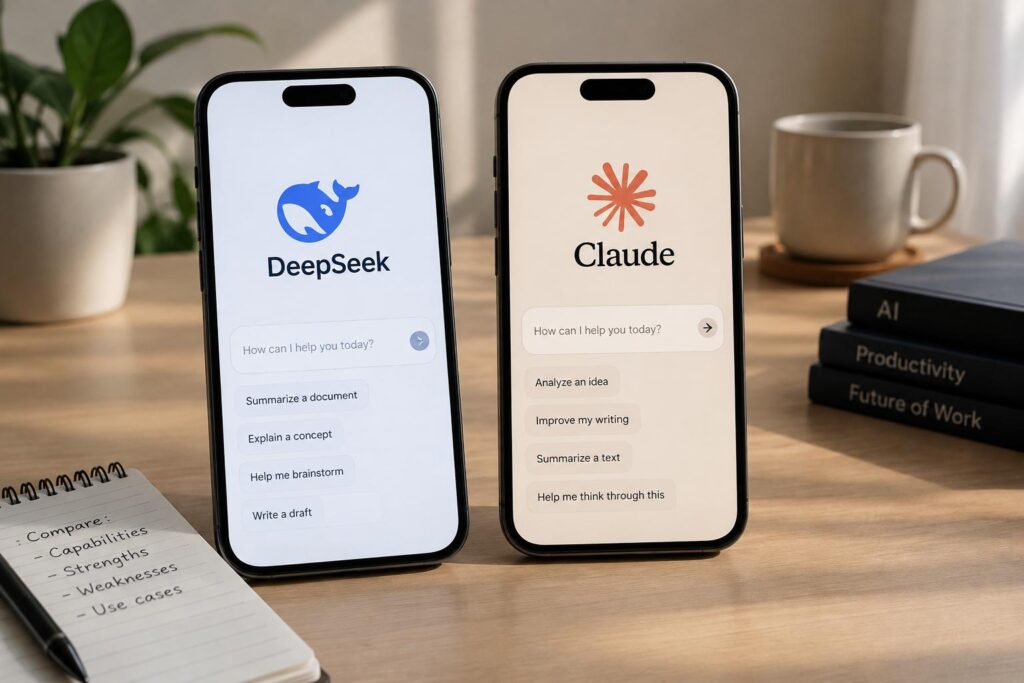
Put two strong AI models in front of the same prompt and the differences start showing almost immediately. One may move faster, another may write with more restraint, a third may reason cleanly but stumble on tone. That is why the conversation around DeepSeek vs Claude: разбор отличий (сравнение DeepSeek и Claude) is more interesting than a simple “which one is better.” The real question is better for what, for whom, and under which constraints.
Both names now come up in serious discussions about writing, coding, research help, and business use. Yet they are often compared in a shallow way, as if all language models were interchangeable. They are not. The gap is not only in benchmark scores or model size, but in personality, product design, practical reliability, and the way each system behaves when a prompt gets messy, vague, or demanding.
I have found that most people do not need a winner in the abstract. They need a model that fits the shape of their work. A developer wants different things than a marketing lead. A founder testing ideas has different priorities than a student organizing notes. So instead of treating this as a sports match, it makes more sense to break down where each model tends to shine, where friction appears, and what kind of user will notice the difference first.
Why this comparison matters now
The AI market has moved past the novelty phase. Companies are no longer impressed just because a chatbot can draft an email or summarize a PDF. They want stable performance, sensible outputs, lower costs, and fewer surprises. In that environment, the comparison between DeepSeek and Claude matters because both are often considered by users who want serious capability rather than a toy demo.
There is also a practical reason this matchup gets attention. Claude has built a reputation for polished writing, careful reasoning, and a generally measured style. DeepSeek, meanwhile, has drawn interest for strong technical performance, especially in conversations around math, coding, and cost efficiency. When people ask DeepSeek или Claude, they are usually deciding between two different philosophies of usefulness.
The timing matters too. Models improve quickly, interfaces change, and what was true six months ago can feel outdated today. That makes rigid rankings less helpful than understanding the deeper patterns. If you know how a model tends to behave, you can adjust as versions evolve.
What DeepSeek and Claude are trying to be
Before judging outputs, it helps to understand the broader character of each system. Claude is widely associated with calm, highly readable responses and a strong emphasis on safe, structured assistance. It often feels designed for users who want clarity, nuance, and fewer rough edges in long-form interaction.
DeepSeek tends to enter the conversation with a different reputation. It is often discussed as technically ambitious, especially in reasoning-heavy and coding-focused contexts. Users drawn to it are frequently testing whether they can get strong capability without relying only on the most familiar Western AI brands.
That difference in positioning affects expectations. People often open Claude when they want a thoughtful partner in drafting, analysis, or extended back-and-forth. They often open DeepSeek when they want to probe raw capability, technical accuracy, or efficiency. Those expectations are not everything, but they shape how each model is experienced in practice.
Writing style and voice: where the difference becomes obvious fast
If your work involves a lot of text, the contrast can appear in the first minute. Claude often produces prose that feels smoother on the first pass. It tends to organize ideas cleanly, keep a stable tone, and avoid the jagged transitions that weaker systems sometimes produce. For many users, that alone saves editing time.
DeepSeek can absolutely write, and in many cases write well, but the texture may feel different. Depending on the prompt, it can be more direct, less polished, or more mechanically structured. That is not always a flaw. In technical contexts, a straighter line from question to answer can actually be preferable.
Where I have noticed the gap most clearly is in nuanced rewriting. If you ask for a paragraph to sound warmer without becoming too casual, or sharper without becoming aggressive, Claude often handles the tonal dial with more finesse. DeepSeek may reach the target, but sometimes with a heavier hand.
This is one of the most practical отличия моделей. A model does not need to “sound human” in a vague sense. It needs to sound right for the job. Claude often feels stronger in brand voice, editorial cleanup, and stakeholder-facing documents. DeepSeek may be perfectly adequate, but the amount of manual polishing can be a little higher.
Reasoning and problem-solving: not just intelligence, but method
When users ask какая нейросеть умнее, they are usually compressing several different questions into one. Do they mean better at math? Better at legal-style reasoning? Better at identifying hidden assumptions in a brief? Better at handling ambiguity without falling apart? “Smarter” is not one thing.
Claude tends to be good at careful decomposition. Give it a messy problem with several moving parts and it often tries to define the frame before answering. That can feel slower, but it also reduces confusion. For tasks that benefit from explicit structure, this habit is useful.
DeepSeek often gets attention for strong analytical or technical reasoning. In coding and mathematical settings, many users test it precisely because they expect a high ceiling on structured problem-solving. When it performs well, it can feel impressively efficient, as if it cuts through ceremony and heads straight to the core of the task.
The catch is that reasoning quality is not only about arriving at an answer. It is also about consistency under pressure. A good model should keep track of conditions, avoid quietly changing assumptions, and recover gracefully when a prompt contains traps or contradictions. In those edge cases, the practical winner can depend heavily on the exact domain.
Reasoning in real work, not in a benchmark vacuum
Benchmarks are useful, but they flatten experience. A model that scores well in a controlled test may still frustrate a user if it explains poorly, overstates confidence, or refuses to adapt when the first attempt misses the point. Day-to-day usefulness lives in that gap.
In my own testing across AI tools, the best model is usually the one that reveals its thinking pattern clearly enough for me to check it. Claude often does that through careful framing and readable structure. DeepSeek can be strong when the task is technically dense and the path to the answer is more formal than conversational.
So if the question is DeepSeek или Claude for “intelligence,” the honest answer is that intelligence shows up differently. Claude often feels wiser in language-heavy analysis. DeepSeek may feel sharper in some technical lanes. Neither label covers every task.
Coding ability: where many users make the final decision
For developers, the comparison becomes less philosophical very quickly. They want to know which model writes cleaner code, spots bugs faster, respects constraints, and avoids hallucinating APIs. This is often the area where model loyalty is won or lost.
DeepSeek has earned attention partly because it is frequently discussed as strong in code-related tasks. That includes generating functions, explaining logic, and working through debugging steps. For users with engineering priorities, this reputation is a major reason the model enters the shortlist at all.
Claude is also widely used for coding help, and many developers appreciate the way it explains what it is doing. It can be particularly useful when the job is not just “write code,” but “review this code, identify trade-offs, and rewrite it in a safer or clearer style.” The explanation layer matters more than many people expect.
The difference often comes down to workflow. If you need raw momentum and technical pattern recognition, DeepSeek may appeal more. If you need collaborative reasoning around architecture, documentation, refactoring strategy, or code review language, Claude can feel more comfortable.
What developers usually notice first
| Area | Claude | DeepSeek |
|---|---|---|
| Code explanation | Often clear, readable, and well-structured | Often direct and technically focused |
| Refactoring help | Strong at discussing trade-offs and readability | Can be effective, especially when prompts are precise |
| Debugging style | Tends to walk through causes methodically | May move quickly to likely fixes |
| Documentation tone | Usually polished and easy to share with teams | Functional, sometimes less refined |
This table is not a scorecard. It is a reflection of tendencies users often care about. The best model for coding is not always the one that writes the most code. Sometimes it is the one that makes fewer hidden mistakes and gives you fewer reasons to distrust the output.
Long context and document handling
One of the biggest practical shifts in modern AI use is the move from one-off prompts to large working sessions. Users now drop in long reports, legal drafts, meeting transcripts, codebases, and research notes. At that point, context handling becomes decisive.
Claude is often praised for document-oriented work. Many users like it for reading, summarizing, and discussing substantial amounts of text while maintaining coherence over long exchanges. When the task involves sustained engagement with a large document, it often feels at home.
DeepSeek’s performance here depends more on the exact setup and version being used, but users commonly test it on the same kind of workloads: long technical text, reference material, and multi-step analysis. The key question is not whether it can process large inputs, but how gracefully it does so and how much fidelity it preserves across turns.
In content-heavy workflows, small failures become expensive. A missed caveat in a policy memo, a dropped variable in a technical explanation, or a summary that smooths away an important contradiction can derail the whole task. This is why context length on paper is less important than practical retention and reliable synthesis.
Accuracy, confidence, and the problem of sounding right
All strong language models share one dangerous talent: they can present weak or false information in a tone that seems fully under control. The real comparison, then, is not only about how often errors happen, but what kind of errors they tend to make and how easy those errors are to catch.
Claude often reads as cautious. In many cases, that caution is helpful because it lowers the chance of a polished but reckless answer. It may hedge more, flag uncertainty, or choose a narrower claim. For research support or business communication, that restraint can be worth a lot.
DeepSeek may feel more forceful in some technical scenarios, which users can interpret as confidence. Sometimes that confidence is earned. Sometimes it simply arrives faster than verification. This is not unique to DeepSeek, but it matters if you work in settings where a plausible error can slip into production.
The strongest habit, regardless of model, is still external verification. If a response contains factual claims, legal interpretation, medical implications, numerical results, or production code, it should be checked. AI has become good enough to save time, not good enough to remove responsibility.
Safety, refusals, and how restrictive each model feels
Safety design changes the user experience more than marketing pages admit. Some models feel flexible until you ask for something borderline, sensitive, or high stakes. Then the product’s underlying philosophy becomes visible very quickly.
Claude is widely known for a careful safety posture. In practice, that can mean more guarded replies in certain categories and more emphasis on harmless framing. For many businesses, that is a feature, not a bug. They want fewer risky outputs, especially in customer-facing or regulated settings.
DeepSeek may feel less constrained in some scenarios, depending on the task and environment. Users who dislike heavy-handed refusals may see that as an advantage. But freedom cuts both ways. The less a model filters itself, the more the user needs to manage quality, risk, and appropriateness.
There is no universal right balance here. A solo developer experimenting late at night may prefer a more permissive assistant. A legal team or enterprise procurement group may prefer a model that is less likely to improvise in dangerous directions. These are not abstract values. They affect purchasing decisions.
Speed, responsiveness, and day-to-day feel
People talk a lot about intelligence, but daily satisfaction often comes from simpler things. How fast does the model answer? Does it stay responsive during longer sessions? Does it require repeated prompting to get into the right lane? These details shape trust.
DeepSeek is often part of conversations about value and performance efficiency, which naturally raises expectations around responsiveness. If a model feels snappy and capable, users are more willing to forgive occasional roughness in style. Fast enough and good enough can be a very persuasive combination.
Claude, depending on the environment and workload, can feel more deliberate. Some users love that because the answer often arrives organized and usable. Others interpret it as a little slower or more formal than they want. This is one of those cases where preference matters as much as raw capability.
I have seen teams choose the model that felt less annoying, not the one that seemed strongest in theory. That may sound unserious, but it is actually practical. If a tool creates friction every day, its benchmark strengths stop mattering.
Cost and access: the comparison businesses actually make
For individual users, cost matters. For teams, it can dominate the decision. A model that is slightly better but materially more expensive may lose out if the use case is broad enough and margins are real enough.
DeepSeek’s appeal is often tied to discussions of efficiency and accessibility. That makes it especially interesting for developers, startups, and organizations that need strong performance without committing to the highest-cost option in every workflow. The price-performance ratio enters the chat very quickly.
Claude, on the other hand, is often chosen because the output quality, writing polish, and document handling can justify the expense for certain tasks. If a model saves an executive assistant an hour a day, or helps an analyst produce cleaner drafts with less revision, the cost equation changes.
In other words, DeepSeek vs Claude: разбор отличий (сравнение DeepSeek и Claude) is partly a budgeting discussion. What you pay for is not only intelligence. You are paying for fit, consistency, product experience, and risk profile.
Questions worth asking before you choose
- Will this model be used mainly for writing, coding, research, or mixed tasks?
- How much do polished outputs matter on the first draft?
- Are users comfortable verifying technical answers carefully?
- How sensitive are the tasks from a legal, compliance, or brand perspective?
- Does the organization value cost efficiency over maximum refinement?
These questions usually lead to a better answer than asking which model is “best.” Best under pressure, best for whom, and best at what are much more useful framing devices.
User experience and interface expectations
A model is not just a model. It is also the product wrapped around it. Interface clarity, file handling, memory behavior, export options, and overall usability can influence which tool people keep coming back to.
Claude often benefits from a product identity built around thoughtful interaction. People who write for a living, manage projects, or work with large text inputs tend to notice and appreciate that. When the interface supports the model’s strengths, the whole experience feels coherent.
DeepSeek may attract users who care less about polish and more about capability, flexibility, or API-level value. That can be a perfectly rational choice. Plenty of technical users would rather have a model with a strong engine than a beautifully upholstered cabin.
Still, product design should not be dismissed as superficial. A rougher interface can increase prompt retries, lost context, and workflow fatigue. Over time, those annoyances become part of the model’s real cost.
Who should choose Claude
Claude tends to make the strongest case for users who live in language. Writers, editors, analysts, consultants, researchers, and managers often care about nuance, structure, and trustworthiness of tone. For them, the quality of presentation is not decoration. It is the work.
It is also a strong candidate when long documents are central to the workflow. If the task regularly involves reading reports, synthesizing interviews, reworking strategy memos, or drafting polished stakeholder communication, Claude’s style and organization can be a real advantage.
Teams that are more risk-sensitive may also lean toward Claude. A somewhat more conservative assistant can be easier to deploy in environments where accidental overreach is expensive. That does not eliminate the need for review, but it can reduce the number of obvious headaches.
Who should choose DeepSeek
DeepSeek is especially compelling for users who prioritize technical tasks, experimentation, or value-conscious scaling. Developers, founders, and advanced users often look at it through the lens of capability per dollar and ask whether they can get strong results without paying a premium for polish they may not need.
It also makes sense for people who are comfortable steering the model actively. If you do not mind tightening prompts, checking outputs, and iterating toward exactly what you want, a less polished but highly capable model can be a smart choice. Not every user needs a gentle conversational partner.
There is another category here too: curious power users. Some people simply want to compare systems in demanding tasks and find the edges for themselves. DeepSeek attracts that crowd because it invites a more technical kind of scrutiny.
The most honest answer to “which one is smarter?”
When people ask какая нейросеть умнее, they often want a clean verdict. Realistically, there is no single answer that survives contact with real use. A model can be smarter in coding and less useful in writing. It can be excellent at extracting structure from documents and weaker at tone control. Intelligence in AI is uneven.
Claude often feels smarter when the task requires judgment expressed through language. It is good at framing, nuance, and producing a response that can be read by a human without immediate cleanup. That matters more than benchmark culture sometimes admits.
DeepSeek may feel smarter in tasks where formal reasoning, technical precision, or coding strength matter most. For users in those lanes, that impression is not imaginary. It reflects a real difference in what they are asking the model to do.
So the better question is not “Which one wins?” but “Which one wastes less of your time while keeping the quality bar where you need it?” That is usually where the practical truth sits.
How to test them fairly before committing
If you are choosing between the two, do not rely on isolated examples from social media. Create a small test set from your real work. Use five to ten prompts that reflect what you actually do, not what looks impressive in public demos.
Include a mix of tasks. Try one writing task, one technical explanation, one revision task, one document summary, and one prompt with deliberate ambiguity. Then compare not only the final output, but how much effort each model requires to get there.
A simple evaluation framework helps. Look at accuracy, clarity, formatting, tone control, speed, and how often the answer needs repair. That reveals the important отличия моделей far better than broad claims from fan communities.
- Use the same prompts in the same order.
- Score outputs on a small rubric.
- Track revision time, not just first response quality.
- Check factual claims and code execution where relevant.
- Repeat the test a week later to see whether impressions hold.
This process sounds simple because it is. Yet it often produces a much sharper decision than hours of reading opinions online.
Where the comparison is heading
This is not a static rivalry. Both model ecosystems are evolving, and the differences users notice today may narrow, widen, or shift entirely. Improvements in context handling, tool use, multimodal ability, and reasoning reliability can redraw the map faster than many buyers expect.
That is why a good decision should be modular. Choose the model that serves today’s priorities, but avoid building assumptions that lock you in emotionally. AI tools are changing too fast for brand loyalty to be a strategy.
The deeper lesson in DeepSeek или Claude is that model choice is no longer about picking the one with the loudest reputation. It is about matching a tool to the grain of the work. Some users need elegance. Some need raw technical force. Some need a balance of the two.
If you care about polished writing, thoughtful document work, and a calmer safety profile, Claude often makes a strong case. If you care more about technical performance, experimentation, and value, DeepSeek deserves serious attention. The gap is real, but it is not mystical. Once you test them on your own tasks, the answer usually becomes much less dramatic and much more useful.
