
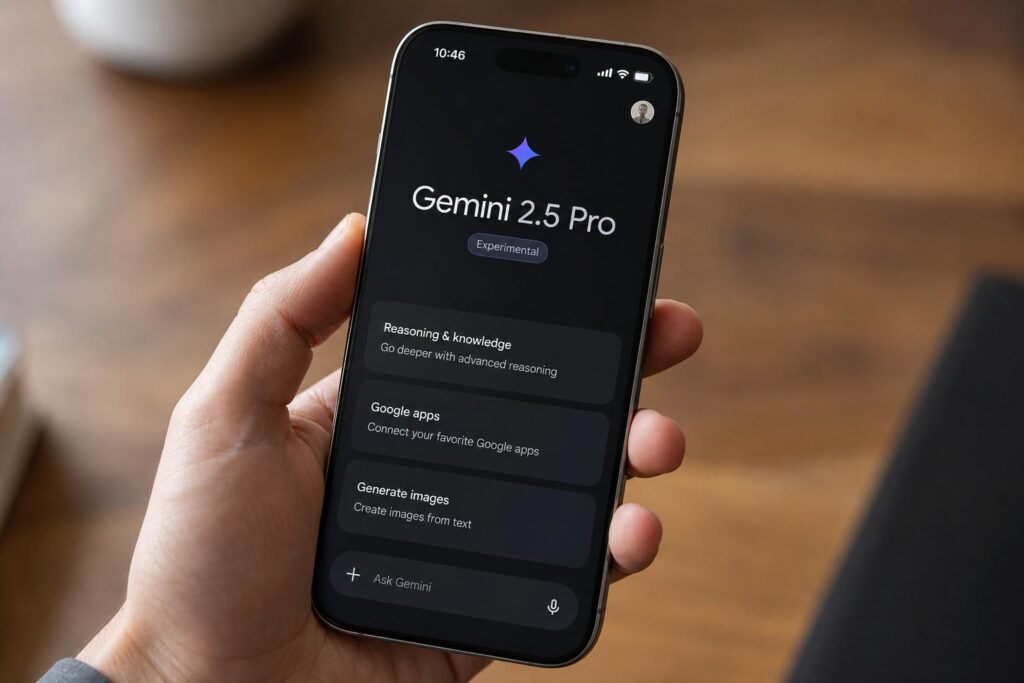
Google has a habit of presenting its AI products as parts of a grand ecosystem rather than as isolated tools, and Gemini 2.5 Pro fits that pattern perfectly. It is not just another large language model with a new version number. It is Google’s attempt to build a top-tier reasoning system that can write, analyze, code, search across formats, and plug into the company’s wider stack without feeling bolted on.
That makes this release worth a serious look. People are not only asking whether it is fast or smart, but also what it is actually good for in day-to-day work, how it compares with rival models, and whether the jump from earlier Gemini versions is meaningful. In this article, I’ll break down what Gemini 2.5 Pro appears to do best, where it stands in Google’s AI lineup, and why this model matters beyond the usual launch-day hype.
Why Gemini 2.5 Pro matters
Every major AI lab now has a “best” model meant to signal technical leadership. For Google, that role belongs to the Pro tier at the top of the Gemini family. The point is not only to score well on benchmarks, but to show that Google can compete in complex reasoning, multimodal work, long-context analysis, and software development tasks—all areas that increasingly define whether a model feels genuinely useful.
That is why a phrase like Gemini 2.5 Pro: обзор флагманской модели Google (обзор Gemini 2.5 Pro) is more than a headline formula. It reflects a real shift in how AI products are judged. Users no longer care only about chatbot fluency. They want systems that can read a giant document set, extract the right detail, generate working code, explain tradeoffs, and stay coherent when the task stretches beyond a few quick prompts.
Google also faces a different kind of pressure than some of its rivals. It already has Search, Workspace, Android, Cloud, YouTube, and a vast developer platform. So when it launches a new flagship model, expectations climb immediately. People assume the model should not just be clever in a demo—it should have a path into real software, business workflows, and consumer products.
What Gemini 2.5 Pro is supposed to be
At a high level, Gemini 2.5 Pro is positioned as Google’s flagship AI model for advanced reasoning and multimodal tasks. “Flagship” matters here. This is the version aimed at harder prompts: messy documents, nuanced writing requests, coding projects, data synthesis, and tasks where the model needs to think through a chain of constraints rather than produce a quick generic answer.
Google’s broader Gemini lineup has included lighter and faster variants for mobile or budget-sensitive use cases, but the Pro label signals ambition. It is the model you use when the work is too demanding for a smaller system, or when accuracy and depth matter more than shaving off a fraction of a second. In that sense, the флагман Gemini is meant to be both a public showcase and a practical engine for serious workloads.
One of the key selling points around recent Gemini releases has been a stronger focus on reasoning. That word gets thrown around a lot in AI marketing, often so loosely that it becomes meaningless. In practice, people usually mean something simpler: Can the model follow a complex set of instructions, break down a problem, keep track of details over a long exchange, and avoid collapsing into vague filler when the task becomes difficult?
That is the standard Gemini 2.5 Pro has to meet. If it can do that reliably, it earns attention. If not, no amount of polished branding will save it.
What people really want to know: what can Gemini Pro do?
When people ask “что умеет Gemini Pro,” they are usually not asking for a marketing checklist. They want concrete use cases. Can it summarize a dense report without stripping out the important nuance? Can it review code like a sharp engineer rather than a talkative autocomplete machine? Can it compare contradictory sources, explain a decision, and handle both text and visual inputs without getting lost?
On that front, Gemini 2.5 Pro is designed to be broad rather than narrow. It can generate and revise writing, answer questions over large document collections, assist with programming, help structure research, and work across multiple input types. That last point is especially important for Google, which has long pushed the idea that the future of AI is multimodal by default, not text-only with a few extra tricks added later.
In practical terms, that means the model is intended to reason over information that may come from text, images, screenshots, diagrams, or mixed materials. For many users, this matters more than it sounds. Real work is messy. A project brief might include a PDF, a slide deck, a spreadsheet excerpt, and a screenshot from a design tool. Models become far more useful when they can move through that clutter without forcing the user to convert everything into plain text first.
I’ve found that this is where advanced AI tools either become part of a workflow or stay as a novelty. If a model can help me read a tangled document set, pull out what matters, and produce something usable in one pass, I keep it open. If I spend half my time cleaning inputs and correcting shallow summaries, it turns into a toy. Google clearly wants Gemini 2.5 Pro to land in the first category.
Core strengths of the new Google model
Among the возможности новой модели Google, four stand out as especially important: long-context handling, multimodal understanding, coding support, and structured reasoning. None of these categories is unique to Google anymore, but the combination matters. Users increasingly want one strong general-purpose model rather than a collection of tools that each do one thing well and stumble on the next step.
Long-context work
Long context is one of those features that sounds abstract until you need it. Then it becomes essential. If you are comparing contracts, reviewing policy documents, analyzing research notes, or tracing a bug across multiple files, a model that can hold a lot of material in view has a real edge.
Google has leaned heavily into long-context capability across the Gemini family, and that strategy makes sense. A model does not become more intelligent simply because it can ingest more tokens, but it does become more usable for real-world analysis. The difference between “I can summarize this paragraph” and “I can compare these 12 sections, find inconsistencies, and explain the implications” is huge.
That said, raw capacity is not the whole story. Many models can take in large inputs and still miss the point. What matters is retrieval inside the context window: whether the model can locate the right detail at the right moment and connect it to the question being asked. If Gemini 2.5 Pro performs well there, it becomes valuable for researchers, lawyers, analysts, marketers, and developers alike.
Multimodal understanding
Google has a credible claim here because multimodality has been central to the Gemini project from the start. Gemini 2.5 Pro is not framed as a text model with image support attached on the side. It is meant to work across formats more fluidly, which gives it a natural role in tasks involving screenshots, charts, interface mockups, scanned pages, and visual references.
This is one area where theory quickly meets reality. A business analyst may need a chart explained in plain language. A designer may want feedback on a wireframe. A student may upload a page of notes and ask for a cleaner explanation. The model’s usefulness depends on whether it can actually interpret the visual material in context, not merely describe obvious shapes and labels.
Google’s advantage is obvious here: it has spent years building systems for image understanding, OCR, search indexing, and cross-modal retrieval. If those strengths are integrated well, Gemini 2.5 Pro could feel less like a chatbot and more like a flexible analysis engine.
Coding and technical problem-solving
Coding has become one of the clearest battlegrounds in advanced AI. It is measurable, commercially important, and brutally unforgiving. A model can sound confident while producing broken logic, insecure patterns, or code that almost works but fails under slight pressure. That is why coding performance often reveals whether a model has real depth or just polished surface language.
Gemini 2.5 Pro is positioned to handle code generation, debugging, explanation, and revision. For developers, the ideal experience is not “write me an app” in one unrealistic prompt. It is more granular and more practical: explain this error, refactor this function, generate tests, spot edge cases, compare two implementation options, or walk through why a query is slow.
In my own experience using high-end models for programming tasks, the best ones are not necessarily those that dump the most code at once. They are the ones that stay steady under follow-up questions. If I ask for a fix, then ask why that fix works, then ask for a cleaner version with fewer dependencies, a strong model keeps the thread. A weaker one unravels. That kind of continuity is where a flagship earns its title.
Reasoning under constraints
This may be the most important category of all. Many tasks that look like “writing” are really reasoning problems in disguise. Think about drafting a memo with conflicting requirements, comparing product strategies with incomplete evidence, or planning a migration under budget and security constraints. The hard part is not the grammar. It is holding the rules together while producing something coherent.
Google has emphasized stronger reasoning in recent model generations, and that emphasis reflects how the market has changed. Fluent text is no longer rare. What matters now is whether the model can think through tradeoffs, follow multi-step directions, and avoid shallow answers when the prompt demands actual structure.
Where Gemini 2.5 Pro fits inside Google’s ecosystem
No review of Google’s top AI model makes sense without discussing ecosystem fit. Google is not selling intelligence in a vacuum. It is building a system that can sit inside Workspace, Cloud services, developer tools, consumer apps, and enterprise environments. That matters because model quality alone does not determine adoption. Availability, integrations, permissions, data flow, and interface design often matter just as much.
For office users, the biggest question is whether Gemini can shorten routine work without creating cleanup work afterward. A polished summary feature inside Docs or Gmail is useful only if it preserves nuance and respects context. For developers, integration with coding environments and APIs may matter more than consumer-facing chat interfaces. For enterprises, the real concern is control: security, governance, auditability, and predictable behavior.
Google is better positioned than many companies to wire a flagship model into products people already use every day. The flip side is that expectations rise accordingly. If the model is deeply integrated, users will judge it not by isolated prompts but by whether it improves actual work in Docs, Sheets, Meet, Android, Chrome, and Cloud workflows.
How it compares in the current AI race
The AI market has become crowded enough that “good” is no longer enough for a premium model. Gemini 2.5 Pro enters a field where top systems are already strong at long-form writing, coding, image analysis, and instruction-following. So the question is less “Can it do these tasks at all?” and more “Where does it clearly stand out?”
Google’s strongest case usually comes from breadth. The company wants one model family that can handle multimodal inputs, complex reasoning, developer tasks, and integration across consumer and enterprise products. That broad strategy differs from products that shine in one benchmark category but feel fragmented in real use.
Still, competition remains fierce. Rival models may be preferred for cleaner writing style, stronger coding consistency, better tool use, or more reliable step-by-step planning depending on the task. In practice, advanced users often settle into a portfolio approach: one model for code, one for writing, one for research, one for image-heavy work. Gemini 2.5 Pro will be most compelling if it reduces the need for that kind of switching.
A practical comparison table
| Area | What users want | Why Gemini 2.5 Pro matters |
|---|---|---|
| Reasoning | Clear handling of multi-step problems and constraints | Google positions it as a top-tier reasoning model |
| Context length | Ability to process large documents and file sets | Long-context capability is one of Gemini’s signature strengths |
| Multimodal input | Useful analysis of text, images, charts, and screenshots | Gemini is built around cross-format understanding |
| Coding | Reliable code generation, debugging, and explanation | Critical for developer adoption and enterprise value |
| Ecosystem fit | Integration with real tools and workflows | Google has a major distribution advantage here |
Where the model is likely to shine
If I had to name the use cases where Gemini 2.5 Pro seems especially promising, I would put document analysis near the top. Google’s long-context and multimodal strengths naturally point in that direction. Give the model a pile of messy materials—reports, notes, screenshots, slides—and ask it to identify the key themes, contradictions, and action items. That is a realistic, high-value task.
Another strong fit is technical assistance for people who are not full-time developers. Product managers, analysts, researchers, and operations teams often need code-adjacent help rather than heavy software engineering. They may want a quick script, a spreadsheet formula, a SQL query, or a clear explanation of an API response. A good model saves them hours. A great one also helps them understand what it produced.
It may also prove useful in editorial and research workflows. Not because it replaces human judgment, but because it can accelerate the first half of the work: organizing source material, identifying themes, comparing drafts, surfacing weak points, and suggesting structures. The final polish still benefits from a human hand. But the early grind can be much faster with a capable model.
Where caution is still necessary
Even a powerful flagship model does not escape the basic limitations of generative AI. It can still hallucinate facts, misread a source, overstate confidence, or produce elegant nonsense when the prompt invites speculation. The danger with stronger models is subtle: they often make errors more persuasively.
This matters most in professional settings. If a model summarizes a legal document incorrectly, introduces a non-existent citation, or recommends a flawed implementation pattern, the problem is not that it “made a mistake.” The problem is that users may trust the answer too quickly because the surface quality is high. Better writing does not equal better truth.
That is why the best way to use systems like Gemini 2.5 Pro is as a force multiplier, not an unquestioned authority. Let it speed up reading, drafting, organizing, comparing, and exploring. Then verify the parts that carry real risk. In other words: use the model to think with, not to stop thinking.
What businesses should watch closely
For business users, the value of a model like this rarely comes down to a single brilliant answer. It comes from consistency over hundreds or thousands of interactions. Can teams rely on it to follow policy? Can they constrain outputs? Can they connect it to internal documents, approved tools, and secure workflows without creating a governance headache?
That is where the возможности новой модели Google become a business question rather than a purely technical one. A model may be impressive in public demos, but enterprise adoption depends on operational details: access control, data handling, observability, latency, cost, and the ability to integrate into existing systems cleanly.
Google has advantages here because it already serves large organizations through Workspace and Cloud. But enterprise buyers are a skeptical crowd for good reason. They care less about spectacle and more about whether the AI helps people do work faster without introducing new layers of review, confusion, or security risk.
What this means for writers, researchers, and everyday users
Not everyone approaching Gemini 2.5 Pro is trying to automate a company workflow. Plenty of people simply want a better general-purpose assistant—one that can help them think through a problem, polish a rough draft, explain a dense article, or make sense of a visual document. For them, the value of a flagship model is often in the quality of interaction rather than the scale of deployment.
Writers, for instance, tend to care less about benchmark bragging rights and more about whether the model can offer sharp structural feedback, spot weak transitions, and generate alternatives that do not sound synthetic. Researchers want source-sensitive analysis and careful comparison, not broad summaries that flatten everything into the same tone. Students want explanations that are clear without being condescending.
The hardest trick for any advanced model is to be genuinely helpful without becoming noisy. A lot of AI tools fail here. They answer every question with too much enthusiasm and too little discipline. If Gemini 2.5 Pro can be concise when needed and deep when asked, it will earn loyalty from users who are tired of overproduced fluff.
Signs of maturity in a flagship model
A true flagship is not defined only by peak performance. It also shows maturity in the small things: cleaner instruction-following, fewer bizarre detours, more stable tone, better handling of corrections, and less tendency to repeat itself. Those qualities rarely dominate headlines, but they shape whether a model feels dependable after the novelty fades.
I often judge a model by how it behaves when I push back on its first answer. Does it listen carefully and adjust, or does it simply rephrase the same mistake with fresh confidence? The strongest systems treat follow-up prompts as part of a real working conversation. They do not just generate text; they track intent.
If Gemini 2.5 Pro continues improving in that direction, it may matter more than any isolated benchmark result. Most people are not using AI to solve abstract test questions. They are trying to get through a day of ambiguous, interrupted, half-structured work. That is a much harder environment—and a much more important one.
Who should pay attention to Gemini 2.5 Pro
Several groups should watch this model closely:
- Developers who need a strong assistant for debugging, explanation, and refactoring
- Analysts and researchers working with large document sets
- Business teams already deep in Google Workspace or Google Cloud
- Writers and editors looking for help with structure, synthesis, and revision
- Power users who want one flexible model instead of juggling multiple tools
That list is broad on purpose. Google is not aiming this model at a niche. It wants Gemini 2.5 Pro to function as a top-level system for professionals, creators, developers, and organizations that need range as much as raw intelligence.
The bigger picture for Google
There is another reason this launch matters: it says something about Google’s strategy in the AI era. The company is trying to turn AI from a standalone novelty into a built-in layer across its products. That means the success of Gemini 2.5 Pro will not be measured only by direct user impressions. It will also be measured by whether it strengthens Search experiences, improves productivity tools, supports developers, and gives Cloud customers a reason to stay inside Google’s ecosystem.
In that sense, the флагман Gemini carries more strategic weight than a normal version update. It is part product, part platform signal. If Google can show that its best model is not just competitive on paper but useful across its software universe, it gains something more durable than launch buzz.
Final take on Google’s flagship model
So where does that leave us? Gemini 2.5 Pro looks most compelling when viewed as a serious working model rather than a demo machine. Its promise lies in the combination of reasoning, long-context processing, multimodal input handling, and ecosystem reach. Those are not flashy extras. They are the traits that increasingly determine whether an AI system becomes part of real work.
Anyone searching for Gemini 2.5 Pro: обзор флагманской модели Google (обзор Gemini 2.5 Pro) is really searching for a simpler answer: is this one of the models worth taking seriously right now? The answer appears to be yes—especially for users who need depth, flexibility, and strong integration with Google’s tools. But like every advanced model on the market, it still demands verification, judgment, and a clear-eyed view of its limits.
That is the interesting part of this moment in AI. The gap between “impressive” and “useful” is getting smaller, but it has not disappeared. Gemini 2.5 Pro matters because Google is trying to close that gap with a model that can handle more of the messy middle where real work happens. If it succeeds, it will not just be another flagship. It will be one of the models that helped define what a practical AI assistant is supposed to be.
