
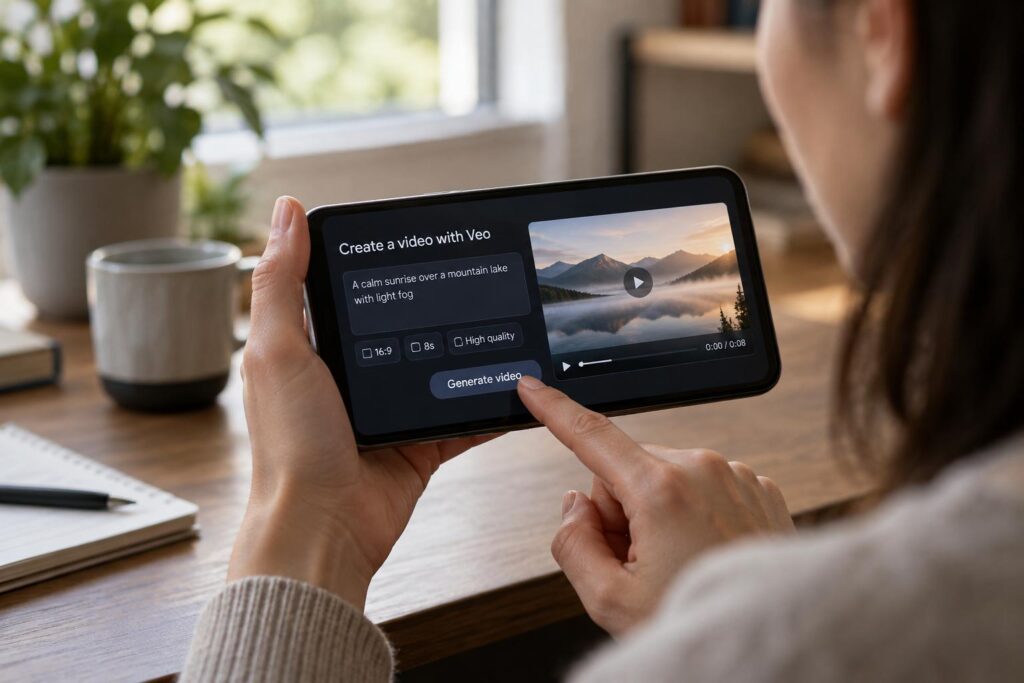
Text-to-video tools have moved from novelty to practical creative software in record time, and Google’s Gemini with Veo sits right in the middle of that shift. What used to require a camera, a crew, and a patient editor can now begin with a prompt, a rough idea, and a few rounds of refinement. That does not mean filmmaking has become effortless, but it does mean the front door is much wider than it used to be.
If you are curious about creating clips with Google’s model, it helps to separate the hype from the actual workflow. Gemini is the interface many people touch first, while Veo is the underlying video generation model doing the heavy lifting. Together, they offer a new way to sketch scenes, test visual concepts, and produce short videos from text and, in some cases, image-based guidance.
This article looks closely at how the process works, what the system is good at, where it still struggles, and how to get more usable results. I will also cover prompt structure, creative strategy, common mistakes, and the practical question every user eventually asks: when does this save time, and when does it create more work than it removes?
What Gemini and Veo actually do
At a basic level, Gemini is Google’s AI assistant environment, and Veo is one of the models available for media generation. When people talk about Создание видео в Gemini через Veo (генерация видео в Gemini), they are usually describing a workflow where a user writes a prompt in Gemini and receives an AI-generated video clip in return.
That distinction matters because the experience has two layers. Gemini handles the conversation, prompt interpretation, and user-facing controls, while Veo is focused on visual synthesis: motion, scene continuity, lighting behavior, camera feel, and subject rendering. In practice, the user sees one smooth process, but understanding the division helps when you troubleshoot weak results.
Google has positioned Veo as a high-capability video model designed to follow cinematic prompts with more detail than earlier generation systems. Depending on the version and product access, it may interpret style references such as lens type, shot composition, movement, time of day, and mood. That opens the door to more precise direction than a simple “make me a video of a city street.”
The phrase Veo в Gemini обзор often appears in discussions for good reason. People are not just asking whether it works; they want to know whether it feels like a toy, a concept art engine, or a serious creative tool. The honest answer is that it can be all three, depending on the prompt quality, your expectations, and the kind of video you are trying to create.
Why this matters now
AI video used to be easy to dismiss because the output was unstable, surreal, and often too short to be useful. That is changing. The newer generation of models is better at preserving subject identity, handling camera motion, and producing images that look less like moving dream fragments and more like directed scenes.
For marketers, educators, app designers, and independent creators, that matters immediately. A short proof-of-concept clip can be enough to pitch an ad idea, test a visual identity, or build a storyboard before any real production budget is committed. That does not replace traditional production, but it can reduce waste and speed up decision-making.
It also changes who gets to experiment. A solo founder can mock up a brand video. A teacher can produce visual explainers without hiring an animator. A filmmaker can test blocking and mood before a location scout. The biggest shift is not that AI can make moving images; it is that more people can iterate visually at the earliest stage of an idea.
How the workflow usually looks inside Gemini
The user experience is intentionally simple on the surface. You describe a scene, style, or action in natural language, Gemini interprets the request, and Veo generates a clip. If the result misses the mark, you refine the prompt and try again.
That sounds almost too clean, and in a sense it is. The real craft lives in iteration. Good users do not write one prompt and hope for magic. They make controlled adjustments: camera angle, pacing, color palette, subject details, framing, movement, and environment.
A practical workflow often looks like this:
- Start with a plain-language scene description.
- Add visual specifics such as location, light, mood, and camera behavior.
- Review the first result for composition, motion, and consistency.
- Revise only one or two variables at a time.
- Save useful prompt variants and compare outputs.
This may sound methodical, but it saves time. One of the easiest ways to waste credits or patience in AI video is to rewrite the entire prompt after every imperfect result. If the motion works but the style is wrong, fix the style. If the scene looks great but the subject is inconsistent, tighten subject descriptors.
What Veo seems to do well
Google’s video model has drawn attention for stronger prompt adherence and a more cinematic feel than many people expect from text-to-video systems. When it performs well, it can generate footage that feels intentionally shot rather than merely animated into motion. That difference is not small. It is the line between “AI experiment” and “useful visual asset.”
Atmosphere is one of the system’s stronger areas. Prompts involving weather, golden-hour lighting, fog, reflections, urban night scenes, and other visually rich conditions often benefit from the model’s strengths. It can also respond well to direct references to framing: close-up, wide shot, overhead shot, slow dolly-in, handheld feel, and similar cinematic language.
The system is especially helpful in previsualization. If you have ever tried to explain a moodboard in words to a client, you know the gap between description and shared understanding can be painfully wide. A generated clip closes that gap quickly. Even when the output is not final-use quality, it can make an abstract idea legible in minutes.
This is where видео от нейросети Google becomes more than a curiosity. It starts functioning as a decision tool. Teams can react to something concrete rather than to a paragraph in a strategy document.
Where the technology still stumbles
No matter how polished the demos look, AI video still has weak points. Complex hand movement, crowded scenes with multiple interacting subjects, fine object continuity, and highly specific character consistency remain difficult. In some generations, a beautiful scene can begin strong and then quietly drift into visual nonsense.
Physics is another familiar trouble spot. Water may move oddly, fabric may behave inconsistently, and interactions between people and objects can lose credibility under close inspection. The model often understands the appearance of an action better than the mechanics of it.
Speech is also worth mentioning. If your goal is a polished talking-head performance with reliable lip sync, emotional timing, and nuanced acting, AI generation alone may not be the right tool yet. Some workflows combine generated visuals with separate voice, editing, or avatar systems, but that is a different production chain from a simple text-to-video request.
The best mindset is neither cynicism nor blind enthusiasm. Think of the tool as excellent at visual ideation, increasingly capable at short-form scene generation, and still imperfect when you ask it for sustained realism or narrative precision.
Prompting for better results
The quality gap between a weak prompt and a strong one is dramatic. Short prompts can work, but vague prompts rarely do. “A woman walking in a city” leaves too much to chance. A better version gives the model direction across subject, setting, time, style, and motion.
Here is the difference in practice. Instead of writing “a dog on the beach,” try “a golden retriever running along a windy Pacific beach at sunset, low camera angle, wet sand reflecting orange light, cinematic slow motion, gentle handheld movement.” The second prompt gives the model far more useful structure.
What helps most is thinking like a director, not like a search engine user. Describe what the camera sees, how the camera moves, what the environment is doing, and what emotional texture the scene should carry. You are not just naming objects. You are staging a shot.
Elements worth including in a prompt
- Main subject and defining attributes
- Location or setting
- Time of day and lighting
- Type of shot and camera movement
- Style or mood
- Specific action taking place
- Details to avoid if the tool supports negative prompting
There is a subtle skill in how much to specify. Too little detail creates generic output. Too much can produce contradictions that confuse the model. If you ask for a “documentary handheld look” and “perfectly smooth drone movement” in the same sentence, you are giving it mixed signals.
A simple prompt formula
A reliable structure is: subject + action + setting + visual style + camera direction + atmosphere. This is not the only formula, but it creates clean, readable prompts that are easy to revise.
For example: “A young ceramic artist shaping a bowl in a sunlit studio, warm morning light, dust in the air, intimate documentary style, close-up shots with slow lateral camera movement.” That prompt tells the model what matters and leaves out what does not.
Prompt examples for different use cases
Different goals call for different prompt styles. A product teaser needs clarity and polish. A fantasy scene needs sensory richness. An educational clip may need cleaner visuals and fewer stylistic flourishes so the content stays readable.
| Use case | Prompt approach | What to emphasize |
|---|---|---|
| Brand teaser | Short, crisp, design-focused | Lighting, product texture, camera motion, background control |
| Concept art video | Atmospheric, descriptive, cinematic | Mood, environment, scale, dramatic movement |
| Educational visual | Clear and restrained | Readability, simple backgrounds, logical motion |
| Social media clip | Fast, visually direct | Immediate hook, contrast, short action beat |
When I test AI video tools, I often build three versions of the same prompt. One is minimal, one balanced, and one highly detailed. The balanced version wins surprisingly often. The minimal prompt lacks control, while the overloaded one can become tangled.
That pattern is useful if you are evaluating ИИ-видео через Gemini for work. Do not assume more words equal better direction. The trick is not length. It is precision.
Using reference images and visual guidance
Some video workflows improve when you give the system a visual anchor. A reference image can help preserve composition, style, wardrobe direction, or the look of a product. If Gemini’s available tools support image-guided prompting in your environment, it is worth using when consistency matters.
This is especially helpful for branded content. If a company needs a particular color palette, packaging design, or interior style, text alone may leave too much room for variation. A reference image can narrow the result and cut down on rerolls.
That said, a reference does not solve everything. Motion still has to be invented, and the system may preserve some visual cues while drifting on others. Think of reference images as guardrails, not as strict blueprints.
Who benefits most from this tool
Not every creator needs AI video, and not every project benefits from it. The strongest use cases tend to involve speed, ideation, and visual prototyping rather than final long-form storytelling. If your job includes pitching, sketching, testing, or producing lots of visual variations, the value becomes obvious quickly.
Creative agencies can use it to mock up campaign directions before commissioning expensive shoots. Product teams can prototype interface scenarios or conceptual launch visuals. Teachers and trainers can build scene-based illustrations for lessons that would otherwise remain abstract or text-heavy.
Independent creators may feel the biggest impact. One person with taste, patience, and decent prompt discipline can now produce material that used to require collaborators. That does not eliminate the need for editing judgment. If anything, it makes that judgment more important.
Veo в Gemini обзор: strengths, trade-offs, and realistic expectations
A fair Veo в Gemini обзор has to acknowledge both the excitement and the friction. The excitement is easy to understand. The model can produce visually compelling clips from plain-language instructions, and in the right hands it feels like a fast-moving sketchbook for cinema.
The friction shows up in repeatability and control. You may get a wonderful result that is difficult to replicate exactly. You may also spend more time refining edge cases than you expected, especially if you need a very specific outcome for commercial use.
In that sense, the tool rewards users who enjoy experimentation. If you need strict determinism every time, AI video can feel slippery. If you are comfortable with exploratory creation, it can feel surprisingly liberating.
One practical way to judge the system is to ask a narrower question: does it get you to a usable draft faster than your old process? For many tasks, the answer is yes. That is a better benchmark than asking whether it perfectly replaces a video crew.
How to refine weak generations
Almost everyone’s first AI video attempts are too vague. The second common mistake is trying to fix everything at once. A better method is to diagnose the output the way an editor or director would.
If the subject looks wrong, tighten the subject description. If the setting lacks mood, strengthen lighting and atmosphere. If the movement feels chaotic, specify one type of camera behavior and remove conflicting instructions.
Here is a useful refinement sequence:
- Lock the subject.
- Lock the setting.
- Define one clear action.
- Add camera language.
- Add style and mood.
This sequence matters because visual identity tends to be the foundation. Once the model understands who or what the scene is about, style and motion become easier to shape. If the core subject is unstable, decorative prompt details will not save the clip.
Common mistakes beginners make
The first mistake is writing prompts that sound like topic labels instead of scene directions. “Cyberpunk city, cool, cinematic” is not enough. It may generate something attractive, but it will likely feel generic because you have not described an event or a point of view.
The second mistake is stacking trendy adjectives without hierarchy. “Epic, stunning, ultra-detailed, beautiful, mind-blowing” gives the model very little concrete guidance. Replace emotional filler with visual specifics.
The third mistake is expecting finished video on the first try. Good AI video creation is iterative by nature. People who treat the tool like a one-click vending machine tend to be disappointed; people who treat it like a collaborative draft engine tend to get much farther.
Quality, safety, and content boundaries
As with other generative systems, access and outputs are shaped by platform rules, model constraints, and safety controls. Those rules can limit certain requests, especially around public figures, harmful content, or sensitive material. Users should expect guardrails and should not build workflows on the assumption of unrestricted generation.
There is also the broader question of authenticity. If you are using AI-generated video in journalism, education, or advertising, labeling and context matter. A synthetic clip can be visually persuasive even when it is entirely invented, which makes responsible disclosure more than a formality.
For business use, rights and usage terms deserve careful review. Availability, licensing, and allowed commercial applications can vary by product tier and policy updates. Before you build a client service around generated clips, check the current terms in the Google product you are using.
How this compares to traditional video production
It is tempting to frame AI video as a replacement for cameras, crews, and editors, but that comparison is too blunt. Traditional production is still better for precise storytelling, consistent performances, and controlled multi-scene projects. What AI does better is speed at the concept stage and flexibility during experimentation.
If you need a founder to speak naturally on camera about a product launch, film the founder. If you need three visual directions for a speculative campaign by tomorrow morning, AI has a strong case. The smartest teams will not treat this as either-or. They will use each method where it actually fits.
I have seen the best results when AI clips are treated as ingredients rather than finished meals. A generated sequence can become a background plate, a pitch artifact, a mood-setting intro, or a storyboard proxy. Used that way, it adds momentum without carrying more narrative weight than it can handle.
Best use cases for creators and businesses
Some applications are already proving practical. Product mood reels, cinematic concept pitches, event promos, social media teasers, app launch visuals, and educational scene illustrations all fit comfortably within the strengths of current generation tools.
For ecommerce, generated motion can help teams visualize how a product might live inside a brand world before a formal shoot is scheduled. For entertainment development, it can quickly test tone, setting, and visual rhythm. For internal communication, it can turn abstract future-state ideas into something teams can react to.
That is where видео от нейросети Google becomes commercially interesting. It shortens the distance between imagination and reviewable output. Even flawed drafts can trigger better conversations than static notes ever could.
Practical tips to get more cinematic output
If your results feel flat, the issue is often not the model but the language. Camera terms matter. Lighting terms matter. Subject behavior matters. “A person in a room” gives the system very little dramatic material to work with.
- Use one clear focal subject.
- Choose a time of day with visual character.
- Specify a shot type such as close-up, wide shot, or overhead.
- Define one camera movement, not three.
- Add environmental behavior like wind, rain, dust, or reflections only when relevant.
Sounding cinematic is not the same as being specific. You do not need to force film-school vocabulary into every line. Often the most effective prompt is the one that paints a vivid, coherent image in plain English.
The role of editing after generation
Even strong AI clips usually benefit from post-production. Trimming, sequencing, color matching, music, captions, and voiceover can transform a loose generated piece into something that feels intentional. Generation creates raw material; editing gives it shape.
This is one area where expectations should stay grounded. If you are producing client-facing material, plan for cleanup. The gap between “interesting output” and “publishable asset” is often closed in the edit, not in the prompt window.
That is also why creators with existing post-production skills often get more value from AI tools than absolute beginners. They know how to salvage, combine, and present material. The model generates; the editor decides what deserves to survive.
What to watch as the tools evolve
The next phase of improvement will likely center on longer consistency, stronger control, and smoother integration with broader creative workflows. Character persistence across shots, better object interaction, and more predictable scene editing would move these tools from “excellent prototype engines” into more serious production territory.
Another important area is multimodal workflow design. The more tightly text, image, video, voice, and editing controls work together, the less fragmented the creative process becomes. Gemini is well positioned for that kind of integration because it already acts as a conversational hub.
For users, the practical takeaway is simple: learn the workflow now, but hold your assumptions lightly. The capabilities are improving quickly, and the habits that matter most are not tied to one version of one model. Clear visual thinking, concise prompting, and disciplined iteration will remain valuable no matter how the interface changes.
ИИ-видео через Gemini as a creative habit, not just a feature
The most interesting shift may be cultural rather than technical. Once people realize they can test visual ideas as casually as they draft text, they begin working differently. They pitch earlier. They explore more directions. They become less precious about first drafts because the cost of experimentation drops.
That does not make creativity automatic. If anything, it exposes taste more clearly. When everyone can generate images and clips, the real differentiator is not access to the tool. It is the ability to see what is worth making, what is almost working, and what should be discarded without regret.
Used well, Gemini with Veo is not just a machine for producing clips. It is a fast visual notebook, a pitch accelerator, and sometimes a surprisingly sharp mirror for your own ideas. If you approach it with clear intent and a willingness to revise, it can become less of a novelty and more of a working method.
That is the real promise behind Создание видео в Gemini через Veo (генерация видео в Gemini). Not instant masterpieces, not the end of filmmaking, and not some frictionless future where craft disappears. Just a powerful new way to move from thought to image faster than before, while leaving plenty of room for human judgment where it matters most.
